Meet Dan Biddle 21 years on from surviving 7/7 against less than a 2% chance
Dan Biddle looked into the eyes of the man who would detonate a bomb on a packed London Underground train.
As the Circle line pulled out of Edgware Road station on 7 July 2005, Dan felt someone staring at him. He was about to challenge it; “What are you looking at?”, when he saw the man place his hand inside a rucksack.
There was a blinding white flash. Heat beyond anything he had ever known.
In an instant, six people in his carriage were killed. Dan, who had been closest to the bomber, was blown from the train into the tunnel. His left leg was torn off. His right leg severed below the knee. He lost an eye, his spleen, his hearing on one side, and suffered catastrophic internal injuries. He would die three times in hospital and be given less than a 2% chance of survival.
It was later said that only his sheer size and muscle mass; 6ft 4in, 19½ stone, had kept him alive at all.
Twenty-one years on, Dan says something that surprises many people: if asked whether he would get on that train today, he would.
“7/7 robbed me of so much,” he reflects. “But it gave me so much as well. It gave me drive. It gave me passion.”
He lives with complex post-traumatic stress disorder (PTSD). The flashbacks never fully leave him, but he believes he survived for a reason. Six people died in that carriage. He became friends with the father of one of the young men killed. “I had to live in their memory,” he says. “I had to show that I cared about my own life, and that I was going to do something valuable with it.”
Dan has since shared his full account in his book, Back From The Dead: The Untold Story of the 7/7 Bombings, a powerful reflection on survival, trauma and rebuilding a life after devastation.
On Thursday 5 March 2026, Dan will share that extraordinary journey as keynote speaker at the AfPP Emergencies and Trauma Symposium at The Royal Society of Medicine, London (8.30am-4.30pm). Bringing together perioperative teams, surgeons, anaesthetists, emergency physicians, air ambulance teams, healthcare researchers, hospital leaders and industry partners from across the UK, the Symposium is designed to unite trauma teams and empower perioperative professionals with clinical insights, practical strategies and resilience tools in emergency care.
At its heart is a story that powerfully reminds us why that work matters.
Ahead of the Symposium, we spoke to Dan about survival, trauma, resilience and the healthcare professionals who fought to keep him alive.
Daniel, what does it mean to you to be speaking at an event that brings together perioperative, trauma and emergency professionals from across the UK?
“It means the world,” Dan says simply. “I owe my life to a large number of people. It’s phenomenal that I am still here.”
On 7 July 2005, Dan was given less than a 2% chance of survival. He died three times. He suffered three cardiac arrests. A surgeon manually massaged his heart to bring him back. He received 87 units of blood.
“I have such a debt to the staff who saved me. If I can do something to help, to make a difference from my experiences, I want to do that.”
For a man who spent 51 weeks in hospital and underwent 74 surgeries, the opportunity to sit in front of the very professionals who dedicate their lives to trauma care is deeply personal.
“That team fought hard for me. Twenty-one years later, I am still here.”
When you think back to 7 July 2005, what moments from that day stay with you most now?
Dan had been brought up in London’s East End. After finishing secondary school, he qualified as a bricklayer but quickly realised he wanted more – moving into project and construction management training.
At 6ft 4in and 19½ stone, he had been a semi-professional football goalkeeper and a boxer. Strong, fit, and used to physical challenge.
Dan describes the day as a series of “sliding doors” moments – small, almost random events that shaped whether he would board that train.
“I woke up with a bad migraine that morning and thought I wouldn’t go into work,” he recalls. “An hour later, I woke again and felt fine, so I decided to go. Then there was a burst water pipe, I even contemplated getting the bus instead of the Tube. I had forgotten my railcard, a train was stopped temporarily, there was a packed train I could have avoided, but instead chose to get on.”
Each of those moments, seemingly minor, added up. “By the time I got on the Circle line train at Edgware Road, all of those little twists and turns had led me to exactly where I was. It’s strange to think how life can hinge on things that seem so insignificant.”
“As we pulled out of Edgware Road, I could feel somebody staring at me,” he recalls. “I was just about to turn around and say, ‘What are you looking at?’”
He looked into the eyes of Mohammad Sidique Khan.
“I saw him put his hand in the bag. Then there was a brilliantly white flash – heat like I’ve never experienced before.”
What has never left him is the calmness of the terrorists. Two decades on, he still sees the bomber in flashbacks. “I can be in the kitchen and he’s standing in the garden,” he says. “Dressed as he was that day, holding the rucksack.”
From your perspective as a patient, what do you remember about the immediate response following the explosion at Edgware Road?
Dan was blown out of the train into the tunnel wall and fell into the crawl space between the wall and the track.
He was conscious throughout.
“Straight after the explosion, you could have heard a pin drop,” he says. “Then it was like opening the gates of hell.”
He saw the six people killed in front of him. He heard the screams. At one point, a rodent ran across him in the 150-year-old tunnel as he lay bleeding.
The first person to reach him was a fellow passenger, Adrian Heili, a former combat medic. “If it had been anyone else,” Dan believes, “I wouldn’t be here.”
Adrian applied a tourniquet and stemmed catastrophic bleeding until paramedics reached him around 30 minutes later.
“My survival is down to Adrian, to the phenomenal care and brilliance of the NHS – and to my wife.”
During those first critical hours and days, were there aspects of the care you received that made a lasting difference to you?
Dan spent eight weeks in a coma and 12 weeks in intensive care. Infection, contamination from the tunnel, and the extent of his injuries meant the odds were stacked against him.
“In these situations, you see the very worst and the very best of humanity,” he says.
One memory stands above the rest.
“I was having major night terrors. I couldn’t sleep. One nurse came off a 12-hour shift and said she would stay with me all night. And she did.”
Each time he woke in terror, she calmed him.
“The bravery, the compassion, it struck me. Teams of people worked tirelessly to keep me alive.”
For clinicians caring for patients in extreme distress, what do you think is most important for them to understand about what patients are experiencing in those moments?
“That a patient like me doesn’t understand what’s going on,” Dan says.
Despite catastrophic injuries, he remembers shouting that he was going to be late for work.
“I was frightened. I had never been in hospital in my life, apart from when I was born. I was terrified.”
He urges clinicians to see past the surface of panic, confusion or agitation.
“Understand it for what it is. Show understanding.”
You sustained life-changing injuries. How did you begin to process the scale of what had happened to you?
“I didn’t process it for years,” he says.
For a long time, he wore what he describes as a mask.
He went from 19½ stone to 10 stone. From physically dominant to feeling deeply vulnerable. He chose not to use prosthetic legs, describing the emotional toll of “losing” his legs each time he removed them. Instead, he built a life in a wheelchair.
For years, he wished he had died. He made three attempts on his life.
“7/7 was like a cancer to me,” he says.
The turning point came in 2013 when he met Gem, now his wife.
“Beautiful, kind and caring,” he says. He asked her to marry him within two weeks.
Returning to Edgware Road station was part of his healing process. After several attempts to get on a train, he finally boarded one with Gem beside him. Staff who had been on duty in 2005 recognised him. They had believed he was dead.
The train stopped at the exact point in the tunnel where the bomb had exploded.
“They stopped it exactly where I’d been lying,” he says. “When I left that day, I thought – that’s enough. I have to move on.”
Was there a particular point where mindset or support became especially important?
“There have been so many amazing people,” he says. “And some not so good.”
But it was love, professional mental health support, and the unwavering efforts of healthcare professionals that helped him rebuild.
“Even when depression hits and I’m in the pit, Gem is there with me,” he says. “She’s my anchor, my support, and reminds me that I’m not facing it alone. That, combined with the care I received, has been vital in helping me keep moving forward.”
How did your experience change your sense of identity?
“I’m very different now,” he says. “But I have drive. I have passion.”
Today, Dan runs a recruitment company with Gem focused on capability, not disability, creating equity and opportunity. He has written a book, Back From The Dead, and dedicates his life to helping others.
“I don’t want anyone leaving hospital thinking their life is over. I don’t want anyone else to feel like that.”
From a patient’s perspective, how important are compassion, communication and human connection alongside clinical skill?
“So important,” he says without hesitation.
“Technical excellence saved my life, but compassion sustained it. When you’re at your lowest, in pain, terrified, or facing life-changing injuries, human connection matters as much as any treatment. Being seen as a person, not just a patient, gives hope, confidence, and the strength to keep going. That combination of skill and empathy is what truly helps someone rebuild their life.”
What role did healthcare professionals play in helping you rebuild your life?
“They were immense. I honestly can’t thank them enough. From the moment I arrived in hospital, through weeks in intensive care, months of rehabilitation, and even long after I left, the care I received went far beyond clinical skill. It wasn’t just about surgeries, medications, or physiotherapy; it was their patience, their compassion.
There were nurses who stayed with me through the night when I couldn’t sleep, surgeons who fought tirelessly to keep me alive after repeated cardiac arrests, and therapists who pushed me to regain movement and strength when I thought I couldn’t go on.
Without them, I wouldn’t be here today. Even in the worst circumstances, care and human connection can make a life-changing difference.”
What do you hope delegates at the AfPP Emergencies and Trauma Symposium will take away from your keynote?
“That everyone’s experience is different. Everyone is an individual,” he says. “No two patients respond to trauma, injury, or emergency situations in the same way. We need to treat people as individuals, not as a homogeneous group.
It’s about recognising that behind every injury or illness is a person with fears, memories, and a life that matters. Understanding that perspective can completely change the way care is delivered, the way patients feel seen, and the way teams approach critical situations.
I want delegates to remember that small acts of empathy, communication, and attention to a person’s emotional as well as physical needs can be just as vital as any clinical intervention. Every patient deserves to be treated with dignity, respect, and the understanding that their experience is uniquely theirs.”
Finally, if there is one message you would like healthcare professionals to carry into their next shift?
“Don’t judge someone by what has happened to them,” he says firmly.
He pauses, letting the words sink in. “Every patient carries a story you may never see; trauma, loss, fear, or experiences that have shaped them in ways you can’t measure.”
“I’m lucky to be here,” he continues. “That team fought hard for me, giving everything they had to keep me alive. And now, 21 years on, I’ll keep fighting every day, not just for myself, but to honour the people who didn’t survive, and to make sure the care and compassion I received continue to matter in the lives of others.”
Join us
AfPP Emergencies and Trauma Symposium
Thursday 5 March 2026
8.30am – 4.30pm
The Royal Society of Medicine, London
Tickets:
£50 AfPP members
£100 non-members
This powerful, practice-focused day will unite trauma teams from across the UK – equipping perioperative professionals with clinical insight, practical strategies and resilience tools for emergency care.
Dan Biddle’s story is one of survival against unimaginable odds – and of the profound, lasting impact of skilled, compassionate healthcare.
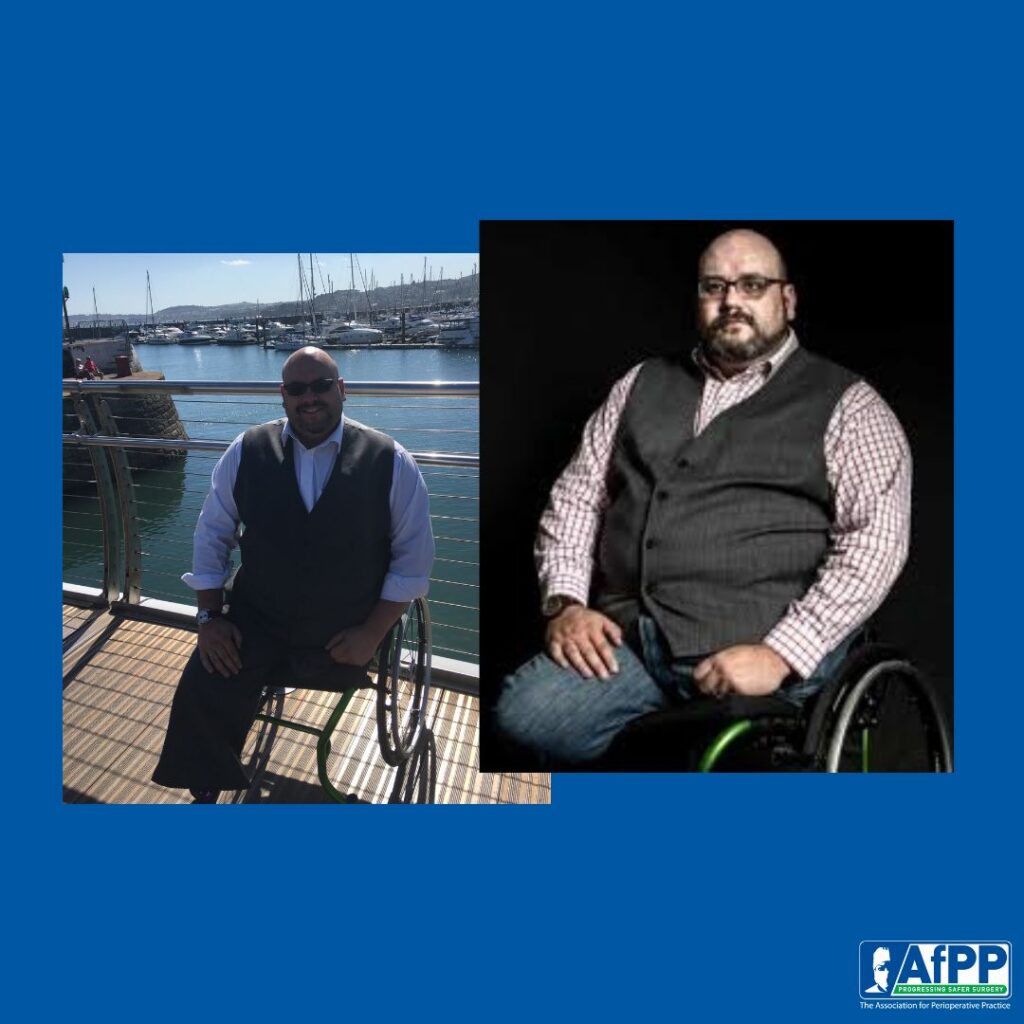
Pictures show Dan.