
Dr DI S. Musser MBA, Head of R&D Surgical
Dr A. Weinert (PhD Chemistry), Head of Technical and Regulatory Affairs
HARPS Europe Manufacturing GmbH (a member of HARPS Global)
Surgical gloves have evolved from simple protective barriers into proficiently designed medical devices that play a critical role in infection prevention, user safety, and surgical performance. Since their introduction in the late nineteenth century, advances in materials science, manufacturing technology, and ergonomic design have continuously improved barrier protection, tactile sensitivity, comfort, durability, and overall clinical performance.¹
For many decades, natural rubber latex was regarded as the gold standard for surgical gloves because of its exceptional elasticity, strength, and tactile performance. However, the recognition of Type I latex allergy among healthcare professionals and patients created the need for alternative materials that provided comparable performance without the allergenic proteins naturally present in latex.² Synthetic polyisoprene emerged as the preferred latex-free material for premium surgical gloves because it closely replicates the mechanical properties of natural rubber while eliminating the risk of latex protein sensitization.¹²
Beyond material selection, modern glove performance is heavily driven by vulcanization chemistry. Conventional sulfur-curing systems rely on chemical accelerators such as thiurams, dithiocarbamates, thiazoles and 1,3-diphenylguanidine (DPG) to achieve the elasticity and tensile strength required for surgical use. Recognizing extractable chemical residues as a critical safety concern, the European norm EN 455-5:2025 establishes a standardized method for their assessment.25 Because residual accelerators can remain in the finished product, they may trigger Type IV hypersensitivity reactions, leading to allergic contact dermatitis in susceptible healthcare workers and surgeons.3-7 However, recent clinical evidence highlights a significant rise among users of synthetic polyisoprene gloves, particularly in DPG allergies, making the elimination of residual vulcanization chemicals a priority in modern glove development.8-10
Aside allergic reactions, chronic hand dermatitis also has important clinical consequences for surgeons. Persistent skin irritation, fissuring and pain reduce glove tolerance, impair comfort during prolonged procedures, and may negatively affect tactile performance and manual dexterity, particularly during double-gloving.2,12,19 In severe cases, occupational hand dermatitis may result in sickness absence, reduced operating capacity and even premature modification or discontinuation of a surgical career.20-23
One approach to reducing the allergenic potential associated with sulfur vulcanization is the use of advanced low-sensitization curing systems. These systems are designed to minimize the presence and migration of compounds associated with Type IV allergic contact dermatitis, while maintaining the elasticity, tensile strength, comfort and barrier performance required for premium surgical gloves. Recent studies have shown that such alternative accelerator technologies can offer a more favorable biocompatibility profile and reduced sensitization potential compared with conventional vulcanization systems.3-6,26
Advances in polymer formulation and curing technology have enabled synthetic polyisoprene gloves to combine excellent mechanical performance with improved skin compatibility. By minimizing residual accelerator migration, modern glove technology addresses both major causes of glove-related adverse reactions: Type I latex allergy through synthetic polyisoprene and Type IV allergic contact dermatitis through reduced accelerator exposure.3-10
Modern surgical glove performance extends well beyond material chemistry. Ultra-thin polyisoprene films preserve tactile sensitivity while maintaining reliable barrier protection. Anatomically shaped formers reduce hand fatigue, optimized surface textures improve grip, and advanced polymer coatings facilitate easy powder-free donning and lasting comfort during prolonged procedures.11-14
Double-gloving is an established strategy for reducing bloodborne pathogen exposure during surgery. Current evidence shows that thin undergloves and anatomically optimized glove systems can preserve dexterity while providing the additional safety of a dual barrier. Color-contrast indicator systems further improve detection of intraoperative glove perforations, enabling rapid glove replacement and reducing contamination risk.15-18
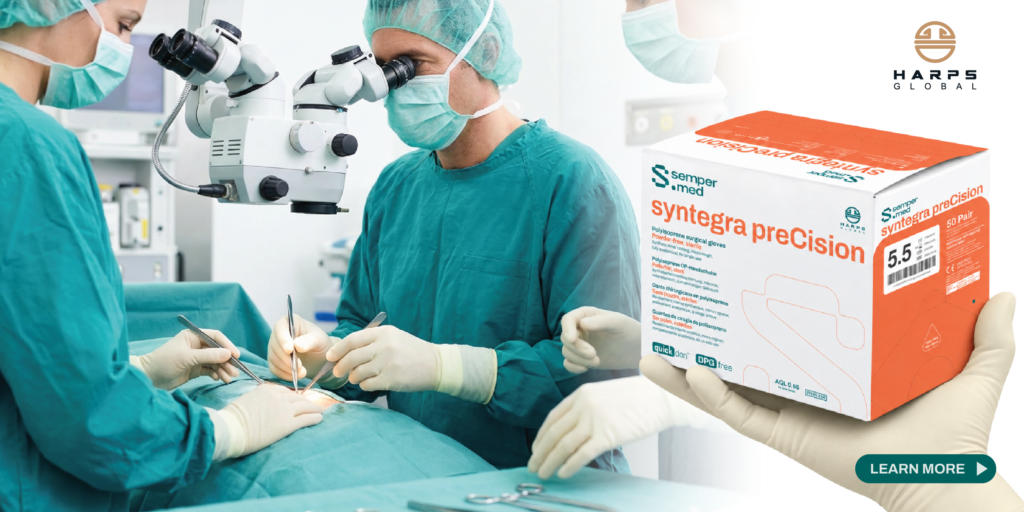
Modern synthetic polyisoprene glove technology therefore integrates advanced materials, ergonomic design and reduced-allergen chemistry to improve healthcare worker safety and surgical performance. Sempermed® syntegra preCision is one example, combining a thin polyisoprene construction with reduced-allergen curing technology to deliver high tactile sensitivity together with reliable barrier protection.24 For double-gloving, a green underglove can enhance puncture indication through color contrast without the usual loss of sensitivity associated with thicker double-glove systems.15-18
HARPS Global, an international group with affiliates worldwide engaged in the manufacture and distribution of surgical and examination gloves, offers these technologies within a portfolio comprising the sempermed products. This includes sempermed® syntegra IR for general surgical applications, sempermed® syntegra preCision as the thinner, high-sensitivity option, sempermed® syntegra UV as an accelerator-free alternative, and sempermed® syntegra green, a green underglove designed to improve puncture indication during double-gloving. Beyond clinical performance and safety considerations, life cycle assessments (LCAs) form the basis of a data-driven sustainability approach, enabling the continuous pursuit of the lowest possible environmental impact across the value chain.