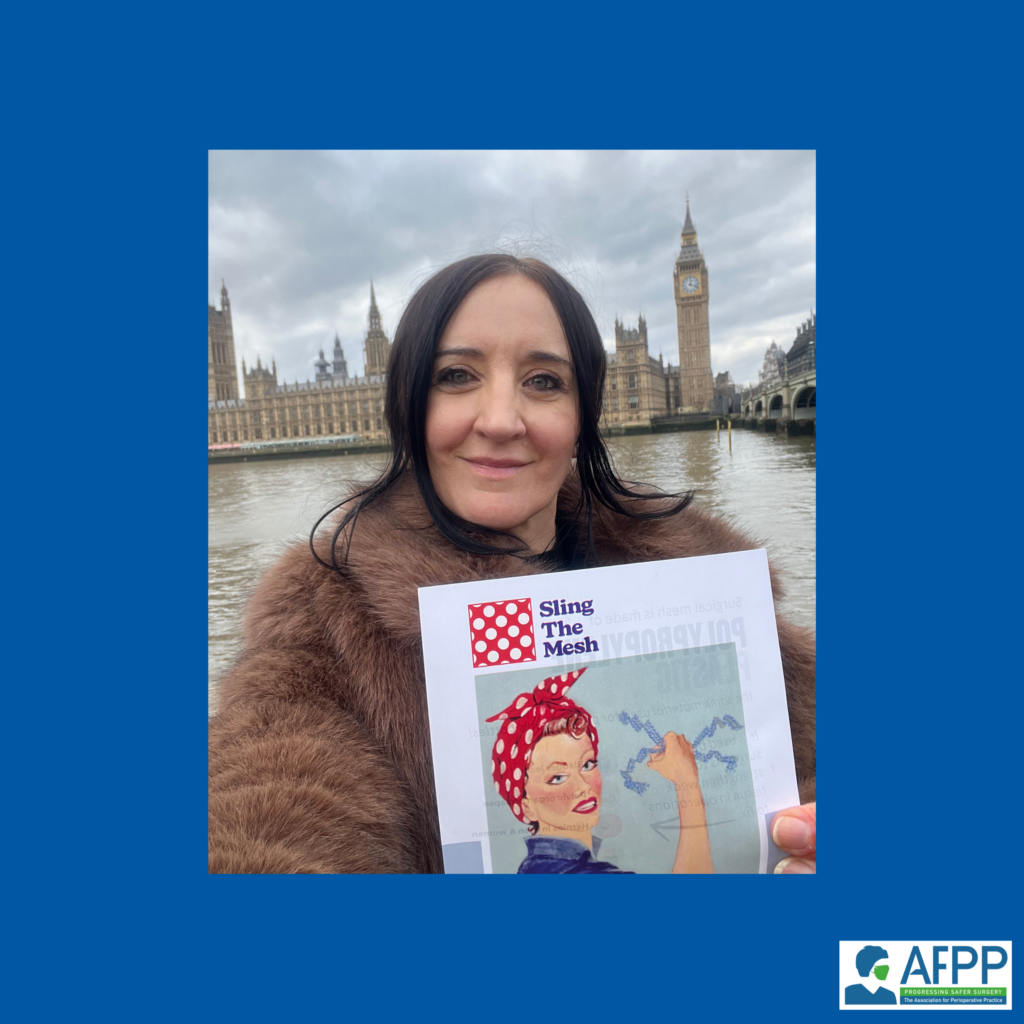
Ahead of this year’s AfPP Annual National Conference, we caught up with Kath Sansom to talk about her work and the message behind her session at conference. We consider why her perspective will be such a compelling part of a conference programme packed with expert voices, fresh insight and practical learning for perioperative professionals.
AfPP: For anyone who may not know your story, could you tell us a little about yourself and what led you to found Sling The Mesh?
Kath Sansom: I’m a former journalist and photographer, and I founded Sling The Mesh in 2015 after experiencing terrible pain and complications immediately following a TVT mesh sling operation. At the time, I was shocked by how little information and support there was for women going through this, and how my surgeon dismissed the pain as trivial and claimed to know nothing of mesh complications – even though later, in the same consultant appointment, he told me he knew of the work of a UK mesh removal surgeon. That was really the turning point for me.
What began with 20 members has since grown into a global network of nearly 13,000 women and men affected by polypropylene surgical mesh used in procedures including prolapse, bladder leaks, hernias, breast cancer reconstruction and some cosmetic breast surgery.
AfPP: Beyond raising awareness, what has Sling The Mesh been working to change for patients affected by mesh complications?
Kath Sansom: At its heart, Sling The Mesh has always been about listening to and empowering people, helping them feel less alone, and pushing for safer, more transparent care. This includes fully informed consent, better data collection on complications, improved care pathways for mesh-injured patients, and stronger evidence on the long-term outcomes of mesh surgery.
I have also been passionate about raising awareness of the flaws in scientific literature, a well-known phenomenon within academia but little understood by the general public.
AfPP: Your work has had a major impact on patient safety conversations. Why does this topic still matter so much right now?
Kath Sansom: For me, this conversation still feels incredibly urgent because patient safety starts with listening – really listening – when people tell you something is wrong. I’ve seen first-hand what can happen when concerns are dismissed or minimised, and that stays with you.
The mesh scandal exposed major issues around informed consent, regulation and long-term follow-up, but it also raised much bigger questions about culture, accountability and whose voices are heard in healthcare. There has been progress, but I believe there is still a great deal to learn if we want to prevent harm and respond better when problems emerge.
When I first began talking about medical misogyny eleven years ago, I was treated as a bit of a nutcase. Media outlets asked me not to use the term, suggesting it could be defamatory. Yet this year, when the government launched their revised Women’s Health Strategy, they formally recognised it as a serious issue in healthcare.
AfPP: Without giving too much away, what can delegates look forward to from your session at the AfPP Annual National Conference?
Kath Sansom: I’ll be sharing some of the human stories behind patient safety failures because, for me, that is where these issues become real and impossible to ignore.
The session will explore empathy, patient voice and what we can learn from the Sling The Mesh experience, including how harm can arise within trusted systems, how patients can find themselves battling to be heard, and the lifelong impact mesh complications can have.
But I also want the session to be constructive. I hope delegates will come away not just moved by what they hear but also thinking about what we can all do differently – how we communicate, how we respond to concerns, and how we create safer systems for patients.
It is a serious topic, of course, but I also hope people will find the session honest, thought-provoking and ultimately empowering. Above all, I want to underline the importance of asking better questions, speaking up, and recognising kindness as a vital clinical skill.
AfPP: Why do you think this conversation is especially relevant for perioperative professionals?
Kath Sansom: I think this conversation will resonate strongly with perioperative professionals because they are so central to the patient experience. They see the importance of teamwork, vigilance, communication and compassionate care every single day. From my perspective, that makes them absolutely vital to the wider patient safety picture.
I hope the session helps connect those everyday professional values with the bigger questions around informed consent, learning from harm, and making sure patients always feel heard.
AfPP: What do you hope people will take away from hearing you speak?
Kath Sansom: More than anything, I hope people leave with a fresh perspective on how powerful their role can be in shaping safer care. I’ve learned that even in very complex systems, small actions can make an enormous difference – asking one more question, spotting an early warning sign, challenging an assumption, or simply taking the time to hear someone properly.
If my session encourages people to reflect, start conversations and think differently about safety and advocacy, then I’ll feel it has been worthwhile.
AfPP: Finally, why do you think delegates should make time for both your session and the wider AfPP Annual National Conference this year?
Kath Sansom: I always think conferences like this are incredibly valuable because they give people the chance to step back from day-to-day pressures, learn from others and have the kinds of conversations that can genuinely shape practice.
I’m delighted to be part of a programme with such a strong range of speakers and perspectives, and I think that is exactly what makes the AfPP Annual National Conference so worthwhile. It promises a fantastic mix of insight, expertise and inspiration, and I think anyone attending will come away with plenty to reflect on and take back into practice.